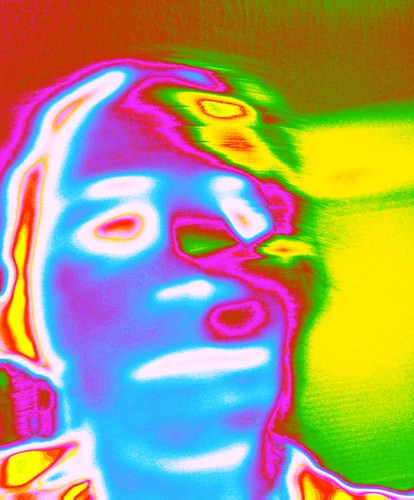
I was inspired by the artists who shared their stories in the film, Who does she think she is?, currently touring North America, which made me laugh and cry. As an afterthought, it still amazes me how, in so many ways, things have not changed radically for women since I was in my twenties. Gender equality is still a work in progress, perhaps even more so for artists than for many other professions. Good film.
Showing posts with label creativity. Show all posts
Showing posts with label creativity. Show all posts
3.17.2009
Gender equality - still a work in progress
9.18.2008
Perception beyond the tangible

"I work in an abstract manner, I am not interested in depicting but in evoking. When the work succeeds, it speaks beyond itself."
- Laura Cater Woods
"Abstraction allows man to see with his mind what he cannot physically see with his eyes. Abstract art enables the artist to perceive beyond the tangible, to extract the infinite out of the finite. It is the emancipation of the mind."
- Arshile Gorky [images][biography][wikipedia]
After taking a number of workshops with quilt artists over the past couple of years I consider Laura Cater-Woods to be one of the best teachers I've had. I had a fantastic experience with her and will take a course with her again if she teaches anywhere near me in the future. What did I like about her? She works with each person individually, she inspires original work, and she appears to deeply connect with the creative spirit in each participant. She has a great sense of humour and does not shy away from discussing any topic. Did I mention technical expertise? Great person, great teacher. She blogs here.
Image of the quilt 'Spring Water' used with permission.
7.07.2008
Quick study: black and white
All of the fine arts should be a source of inspiration for quilt artists. -Pamela Allen
I am feeling real happy to be taking a five-day course this week with quilt artist Pamela Allen, who is known for her quirky, humourous and very colourful art quilts. The course, called Think like an Artist is offered as part of the Summer Academy of the Arts program at Algonquin College in Ottawa. Below is the result of a quick study in black and white that I did this morning. Not sure what I'll do with it next. Pamela teaches a neat appliqué stitch for holding these raw edge fabric pieces down to the background which looks fast and adds some nice texture to the work. I might try that, or I might do a more quick and dirty version with the sewing machine.
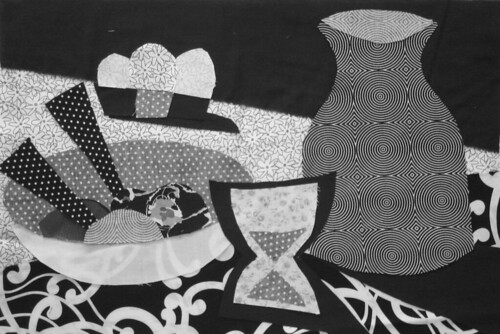
Black and white still life
Commercial cottons
8 x 12"
4.30.2008
April TIF - Part II
In my last TIF post I mentioned an unbidden image which came up for me when I read Sharon B's April TIF concept. I said I would incorporate that image into my April TIF challenge piece.The image was of myself as a baby in a crib. I've heard some stories over the years from various family members about those early days. Not all of them very happy ones. I have the sense that a lot of us may have been asked to spend quite a bit more time our cribs than was actually necessary. Just a guess. Probably for that reason, I'm not a big fan of cribs. Both my daughters slept with my husband and I for the first few months after which we moved them to a futon on the floor of their own bedroom. It was much easier to change the baby, put her down to sleep and easier to deal with her when she woke up crying in the night; we would just go in and lay down for a while on the bed. It worked for us. I thought about the crib image for a while, not sure how it might inspire a small quilt or piece of textile art. After awhile I came up with the idea of a repeat block based on the bars of a baby crib. Below left is an image cropped from a photograph of a crib. Below right is a quilt block based on the image.
 |  |

I added some colour, and an orb (below left),to suggest the sun rising, thereby representing the passage of time which I also said that I would incorporate into this piece. Then I shifted the orb to the right side of the piece (below right),
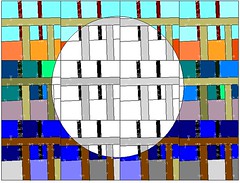 | 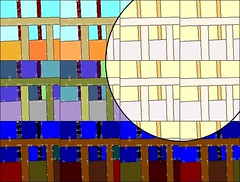 |
and simplified the whole thing somewhat by removing half of the blocks for a total of six blocks instead of twelve. I also flipped over some of the blocks to break up the patterning a bit. The sun then became a much bigger part of the overall composition.

I wasn't sure what kind of a time commitment this would turn out to be but the next step was to take it to fabric, which would represent the element of positive transformation that I also wanted to convey in the work. The idea of positive transformation is also addressed by taking a somewhat heavy memory and injecting it with colour and movement.
4.24.2008
Quilting as a metaphor
"[In] my 'Secret Garden' series [link]...I take as a starting point, old memories of gardens of my childhood with their combination of water paths and foliage. This also becomes a metaphor for deeply embedded old memories that rise unbidden in our consciousness; sometimes clear and structured, sometimes vague and formless. Quilt-making with its multiple layers seems an ideal medium for exploring these ideas." - Rosalie DaceI have an opportunity to take a one week class with Rosalie Dace who is teaching at Quilting by the Lake this year. I have looked at her work on line [link][link] and read about her on a handful of websites and blogs. Her quilts are absolutely sumptuous and appeal to me directly. As well, she appears to be a process person; no patterns or kits provided. On her website she states that her interest is in helping students to bring out what is personal to them in their work, and to encourage them to stretch beyond what they think is possible for them. Great! I am hesitating to proceed though, because I attended a class at the same conference last year and had a very mixed experience, largely because the class I took was poorly organized and, I thought, did not deliver what had been advertised. I would hate to set aside this kind of time and financial resource again for a repeat experience. However, all things in life present certain risk, along with the concomitant possibility of benefit or great gain. So, I'll ponder on it for a few more days and think about the benefits that this experience has to offer. It has long been personal challenge for me to let go of preconceived expectations about how things should or shouldn't be, a challenge which requires a heightened trust in life and in people, and a willingness to allow things to unfold as they may.
3.14.2008
TIF March 2008
My TIF challenge piece this month uses SharonB's concept and colour scheme (well, OK, I swapped a couple of colours). She writes,
Do you ever notice the little things, the small moments, the details in life? This month's challenge is to do just that, pay attention to the tiny details. Sometimes the small things become emblematic for something larger.In Toronto last week I walked by this window display at the Mokuba ribbon shop at 575 Queen Street West, a bit hard to see in this photo due to the glare on the window, but it gives you an idea.

These three simple, yet beautiful hangings, made of coloured ribbons, inspired me to create something that would capture this small detail of a walk in the city; a colourful window display on a snowy, white winter day. This is the little thing that got me started on my March TIF piece.
 First I played around with a couple of strips of paper painted with acrylic, twisting them in different ways to see what kind of patterns I might get.Above is an example of something I liked. |  Then I painted some brown packing paper in several colours, the purple, green and gold are from Sharon's colour scheme, though they darkened up considerably when they dried. |
 Dried and fused the paper and cut it into strips. |  Starting to play... |
 ...going somewhere... |  ...adding the last strips of twisted paper ribbon. |

Ribbons on Queen Street
Acrylic, paper, raw canvas
fused
16 x 19"
March 2008

detail
1.23.2008
Shibori Girl's Pay it forward exchange
You probably already know Shibori Girl a.k.a. Glennis Dolce, who is among other things, a talented shibori artist and photographer. In October 2007, Glennis posted her own personal twist on Pay it forward and I gladly jumped at the opportunity to participate. Glennis promised to make a handmade gift for anyone who went out and taught some kind of art to children. To fulfill my commitment I began teaching fabric dyeing in my daughter's elementary school classroom. I have been there several times now and the teacher has asked me to continue teaching there every second Monday morning until the end of the school year. Below is a slide show of some things that we have done so far. The students have shown a real enthusiasm for fabric dyeing and I am quite happy about the way things are going. Toward the end of the school year I hope to gather all of the dyed fabric together and make one large quilt or smaller individual quilts using the fabric the students will have created.
Today on her recently created blog Elementary Art Exploration Glennis wrote that she is mailing her handmade gifts today, so I thought it would be a good time to report on what we've been up to in the classroom. The flickr slideshow below was made using Paul Stamatiou's HOW TO Quickie:Embedded Flickr Slideshows.
11.02.2007
Throw yourself into realms that call to you
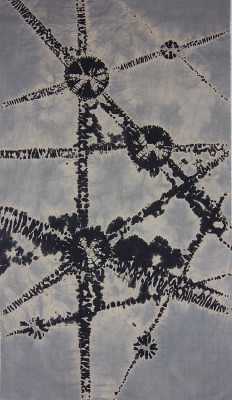
Chaos
by Tela Shibori
Maki-age and ori-nui Shibori
Black cotton discharged with thiox
11 x 18"
October 2007
by Tela Shibori
Maki-age and ori-nui Shibori
Black cotton discharged with thiox
11 x 18"
October 2007
"Be willing to throw yourself into realms that call to you, realms that for you embody important truths. There is no regret in life more intensely painful than not following the path to which your own ideas point. Believe in yourself and your ideas. This is called integrity. It keeps you whole and preserves your self-respect. You may have great leaps of imagination that no one at this moment believes in but you. It is a true test of your worth to be able to withstand the forces of being out there alone with your values. It is a place that most creative people come to many times in their lives. You learn to value it, understand it, and weather it. You may even grow to crave it." - Susan Brandeis, "A Creative Life", Surface Design, Winter 2007 Volume 31:2
To see the piece pictured above after it was stitched and before it was gathered and discharged, take a look here.
6.18.2007
The creative habit
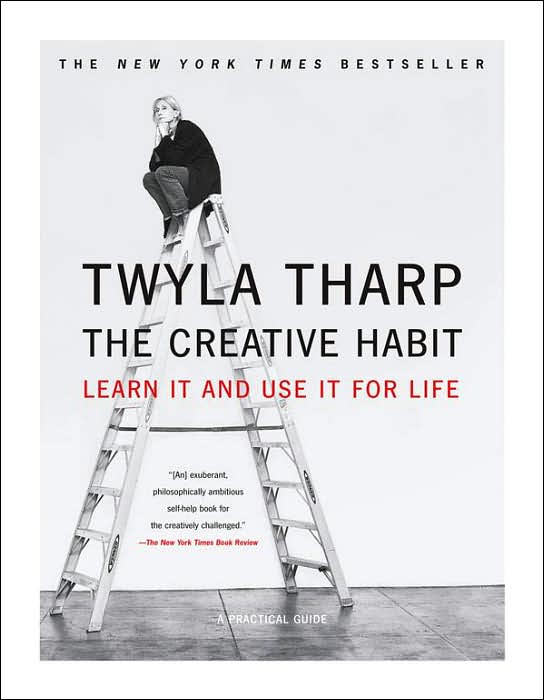
This book has got me thinking about the physical part of creating a body of work. By this I don't mean doing the work. I mean placing yourself in time and space, on a regular basis, in a way that will optimize the probability of getting something done. In a recent post I wrote about setting some goals for my quilt making over the next two years. One of my goals is to set aside a certain amount of time each week to work. My big push for the next year will be to develop a creative habit. Since I am a morning person this would logically mean working in the morning. I think it would look something like this:
"It's vital to establish some rituals -- automatic but decisive patterns of behavior -- at the beginning of the creative process, when you are most at peril of turning back, chickening out, giving up, or going the wrong way...Thinking of it as a ritual has a transforming effect on the activity. Turning something into a ritual eliminates the question, Why am I doing this?"
"In the end, there is no one ideal condition for creativity. What works for one person is useless for another. The only criterion is this: Make it easy on yourself. Find a working environment where the prospect of wrestling with your muse doesn't scare you, doesn't shut you down. It should make you want to be there, and once you find it, stick with it. To get the creative habit, you need a working environment that's habit forming. All preferred working states, no matter how eccentric, have one thing in common: When you enter into them, they impel you to get started." -Twyla Tharp, The creative habit, Learn it and use it for life
- 5-7 AM: Get up and do one hour of back strengthening exercises and Pilates on the ball.
- Eat breakfast
- Work. This means creative work e.g., designing, dyeing, piecing, or quilting, nothing else. Can probably work for up to four hours depending on what time I get started. Break for lunch.
In The creative habit, Tharp includes exercises throughout the book. In one exercise she gives a list of questions which are to be answered, quickly and instinctively in order to provide a kind of self-appraisal to the reader of her creative identity, that is, what kind of creative work is the reader most compelled to make, what point of reference is she most inclined to take, from what distance, and so forth. One of the questions was: "What is your ideal creative activity?" For me, two answers came to mind simultaneously: -- creating an image and -- creating a functional object. It occurred to me that here is one of the core reasons that I love to make quilts: because they encompass both of these creative activities. Wish me luck instilling a creative habit.
3.20.2007
Art and fear
Making art and viewing art are different at their core. The sane human being is satisfied that the best he/she can do at any given moment is the best he/she can do at any given moment. Such sanity is, unfortunately, rare. Making art provides uncomfortably accurate feedback about the gap that inevitably exists between what you intended to do, and what you did. In fact, if artmaking did not tell you (the maker) so enormously much about yourself, then making art that matters to you would be impossible. To all viewers but yourself, what matters is the product; the finished artwork. To you, and you alone, what matters is the process: the experience of shaping that artwork. The viewers' concerns are not your concerns (although it's dangerously easy to adopt their attitudes.) Their job is whatever it is: to be moved by art, to be entertained by it, to make a killing off it, whatever. Your job is to learn to work on your work.
In a large measure becoming an artist consists of learning to accept yourself, which makes your work personal, and in following your own voice, which makes your work distinctive.
- excerpted from Art & Fear: Observations on the Perils (and Rewards) of Artmaking by David Bayles and Ted Orland


3.08.2007
An interesting conversation
An interesting conversation is going on over at Ragged Cloth Cafe in the comments of the March 4 post We've All Got Something to say. One of the gems of that conversation was a quote offered up by Clairan Ferrono from Patricia Hampl's book Blue Arabesque:
A painting must depict the act of seeing, not the object seen...,which made me recall a quote I read recently on Contemporary Art Quilts Lens:
Art actually lies in the act of creation, not in its result. -G. Ellis Burcaw, Introduction to Museum Work.Along these same lines, Nancy Crow said:
The only thing that matters in the end is that the talent has evolved, has been nourished, and that a legacy has been left behind. -1995.The kernel idea for me here, the idea that has been the spark for me to better understand why a physical interpretation of beauty or experience (a work of art) is so compelling, is that whether or not we know it when we are looking at it, art is essentially a process, an action, a verb, an experience, encompassing both the creator, her finished work and the viewer.
3.02.2007
The amazing maternal counter-force
Besides being a great storyteller Melissa, who created Fabric Dyeing 101, has put together a truly comprehensive resource for anyone who is interested in dyeing fabric or starting her own business. Here's how she begins The Story of My Hand-dyed Fabric Business:It started very simply. I wanted to make an Amish style quilt with solid colour fabrics and I started searching for the colours I wanted. At the time, my youngest was an avid breastfeeder (and the size of a small planet) and all those hours of sitting, watching, holding the baby invoked that amazing maternal counter-force that says, if I can do this (motherhood), I can do anything. Having a baby to care for, for many of us...summons up independent creative forces that know no limits.
Eventually, unable to find fabric in the colours she was looking for Melissa started to dye her own. I read her story some time ago and what she wrote about motherhood stayed with me, mainly because it's reassuring to have someone articulate something that you've felt but didn't quite have the words for. My daughters were two and four when I returned to quilting and started dyeing fabric a year-and-a-half ago. Not only have dyeing and quilting been a total blast but doing these things gives me something that I have not found anywhere else; this creative work, and especially working with colour, fills me up and returns me to a state of focussed concentration and peace that I apparently need in regular doses.
My attitude about myself in relation to my art has also changed a lot. When I see a piece that I admire or that inspires me, my mind rarely goes to "I am not talented enough to do something like that" as it often used to. Instead I am able to be much more open and to take in and also appreciate what I am seeing. What I have discovered is that not only do I *need* to look at other people's work but I also *need* to create, to put something physical out into the world , something that is beautiful to me, or something that helps me to work through a feeling or an experience that I've had. I now recognize this as a strong need in me, not just something I enjoy doing.
My connection to the "rightness" of the impulse to create is more accessible to me now than it was before. In part I credit this to the fact that my own time has been pared down to a fine sliver each week. Practically speaking, there's not much time to waste in self-doubt. In part I credit it to the fact that young children are still very in touch with an unfettered and core part of their humanity; spontaneity, boundless exuberance, affection, an insatiable curiosity, joy, tenderness, and a lack of self-consciousness in much of what they do is on display most of time. I am also more in touch with in myself, the things that I wish for them, namely, compassion, groundedness, challenge, connection, courage, openness and a certain amount of inner peace, the kind that, no matter what life hands them, they'll still be able to breathe deeply, and come back to themselves. Parenting is just one route to seeing certain things more clearly, and perhaps, it was something entirely different that got me here. Whatever the reason, I'm happy to have found the freedom to let go of some of the self-criticism.
2.06.2007
Transfigured
When an artist looks at things, she doesn't see them literally as they are but as her imagination transforms them, into workable images for things that are going on in her mind.I checked the National Film Board video, Transfigured: Jack Shadbolt Inside the Mind, out of the public library. It is an amazing piece of animated work. It is Stephen Arthur's celebration of contemporary Canadian artist Jack Shadbolt's paintings. If you can get a hold of this video I recommend it. It's a beauty. More of Jack Shadbolt's work is here.
- Jack Shadbolt
The Ottawa Rideau Canal Skateway finally opened this year. We skated the length and back this evening. The ice was perfect. If you've never been on the Rideau Canal in winter try a virtual skate. Click here and then click on SKATE THE CANAL. It just might convince you to come and skate it for yourself.

Subscribe to:
Posts (Atom)