Showing posts with label quilt. Show all posts

3.13.2009

Human Marks

"A stitch is a very credible mark." - Dorothy Caldwell


kanthaCropped

Free-hand stitched kantha sampler
Embroidery floss on
two layers of black cotton
4 x 7 inches


I stitched this in a two-day class called Human Marks taught by Dorothy Caldwell, offered through the Kingston Fibre Artists' Guild. The course was designed to run for five days so the two-day class was a somewhat condensed version. Nevertheless, I had the impression of things slowing way down. We worked with our fingers and ink, pens, brushes, candle smoke, wax, hammer and nail, and needle and thread to make marks of one sort and another, repeating them, overlapping them, changing speed and direction and so on.

It seems to me that most of what I produced, expressed by way of many discrete marks, suggested not so much a series of images, but something unintended or unconscious, the suggestion of something, perhaps something forgotten. An interesting couple of days, and a nice trip away from home.

If you find yourself in that neck-of-the-woods be sure to check out the Kingston Fibre Artists exhibit, Inspiration and Exploration currently at the Kingston Public Library, 130 Johnson Street, Feb 28 - March 30.

10.20.2008

Red Onions

redOnionsCropped

"Red Onions"
Commercial and hand dyed cottons
Raw edge applique, hand and machine quilted, hand tied

11 x 11"
2008

This piece is going out to Susie Monday of El Cielo Studio in partial fulfillment of my participation in the Pay it Forward Exchange. Another small piece that I did this year, called Hopscotch, will go out to Amy Moak of All My Stuff, who also signed up to receive something handmade from me, in return for her participation in the challenge. Thank you Susie and Amy for your interest.

And while I'm at it, I thought I'd mention the annual Shadowbox exhibit, which is currently on at the Textile Museum of Canada in Toronto. Browse the textile art gems currently on display at the museum's website. The exhibit is a fundraiser and all works are for sale by bidding. Bid in person at the show or if you have the cash, attend the Shadowbox Auction and Cocktail Party. I especially like this one entitled Cutting Edge by Kate Hyde.

9.18.2008

Perception beyond the tangible


Spring Water
Laura Cater-Woods

"I work in an abstract manner, I am not interested in depicting but in evoking. When the work succeeds, it speaks beyond itself."

- Laura Cater Woods

"Abstraction allows man to see with his mind what he cannot physically see with his eyes. Abstract art enables the artist to perceive beyond the tangible, to extract the infinite out of the finite. It is the emancipation of the mind."

- Arshile Gorky [images][biography][wikipedia]

After taking a number of workshops with quilt artists over the past couple of years I consider Laura Cater-Woods to be one of the best teachers I've had. I had a fantastic experience with her and will take a course with her again if she teaches anywhere near me in the future. What did I like about her? She works with each person individually, she inspires original work, and she appears to deeply connect with the creative spirit in each participant. She has a great sense of humour and does not shy away from discussing any topic. Did I mention technical expertise? Great person, great teacher. She blogs here.

Image of the quilt 'Spring Water' used with permission.

9.08.2008

Many sources for inspiration


small_inspired


Untitled
Commercial and hand dyed cottons
11 x 11"
Unfinished


This was begun in the class I took over the summer with Pamela Allen, a fabulous teacher who I can not recommend highly enough. Each student was given a small square cutout of a partial work by a well known artist and asked to create a small quilt around it. I was given the piece with a white vase and onions that you can see in the upper left hand quarter of the quilt. It was taken from a still life by Matisse called, 'The Red Onions' painted around 1906.

7.07.2008

May TIF - Part II

I tried a few new things with May's TIF piece: photo transfer paper, oil paint sticks and hand tyeing. The image of a heart was drawn by Jason Reid and used with permission. For more info about the concept read here.


mother_rotated

Mother
Hand dyed and commercial cottons;
Shiva paint sticks, photo transfer;
Machine pieced, hand and machine quilted,
hand tied;
14 x 20"
July 2008


detail

Detail


Related post: May TIF - Part I

Quick study: black and white

All of the fine arts should be a source of inspiration for quilt artists. -Pamela Allen

I am feeling real happy to be taking a five-day course this week with quilt artist Pamela Allen, who is known for her quirky, humourous and very colourful art quilts. The course, called Think like an Artist is offered as part of the Summer Academy of the Arts program at Algonquin College in Ottawa. Below is the result of a quick study in black and white that I did this morning. Not sure what I'll do with it next. Pamela teaches a neat appliqué stitch for holding these raw edge fabric pieces down to the background which looks fast and adds some nice texture to the work. I might try that, or I might do a more quick and dirty version with the sewing machine.


b_WCrop

Black and white still life
Commercial cottons
8 x 12"


6.28.2008

May TIF - Part I

What do you call yourself and why?

was May's TIF Challenge concept question. I got started on it last weekend. Yes, I know it's the end of June but I liked the concept question and decided to do the assignment anyway.

Presently, if asked, I call myself a mother and a quilt artist. Making this small quilt top partly addressed the identity of quilt artist. In addition I included a strip of a traditional quilt block: flying geese, to further speak to this identity in a straightforward way. I decided to use an anatomical human heart to describe my role as a mother. In western culture the heart is used to represent or symbolize many of the attributes that are essential in the day to day care and nurturing of young children. Among these, love and compassion, honesty, forgiveness, and joy, are supremely important. Additional requirements necessary for effective parenting, and commonly symbolized by the human heart, include stamina, endurance, strength, good health and steadfastness. The image of a heart was drawn by Jason Reid and used with permission. I fragmented the heart to represent the reality of struggle or hardship, which along with joy, is part of family life. In overall design the quilt is a simple collage of fabrics.


quiltTop


The piece was made as a prototype for a larger quilt that I want to make, to further address the question posed by the May TIF challenge question in which I intend to use several unfinished drawings that I made recently in a drawing class. Here in the smaller quilt, I experimented with photo transfer paper for textiles and used three different products to transfer the drawing of the human heart onto fabric. The products I tried were June Tailor Print 'n Press, Wilton Easy Image fabric transfers and HP iron on transfers. I was most happy with the results that I obtained with the HP transfer paper, as it was the least stiff and resulted in less colour distortion than the other two products. It was also the least expensive.

Oh yeah, and don't forget to flip your image before you print it to the transfer paper as the transferred image will be the reverse of what is printed on the paper. As you can tell, if you closely examine the image of the heart.

In truth, I would like to find another way to transfer drawings and digital images to fabric, one that would better retain the hand of the fabric which transfer papers do not do. Something that I would like to learn more about, is digital printing with fibre reactive dyes, a technique used by quilt artists Michael James and Miriam Nathan-Roberts. If you use digital image transfer techniques in your textile art which you can recommend please leave me a comment or drop me a line about what works for you.

6.27.2008

Masters: Art Quilts

Have you seen the new book Masters: Art Quilts: Major Works by Leading Artists?
I was captivated by the quilts included in it. Among other artists, it was great to see more works by German quilt artist Inge Hueber, whose quilts I first saw in Robert Shaw's book The Art Quilt. She has developed a unique style using visible seams and layering, to depict texture and depth. Of her work she states:

"My quilts have developed into a kind of visual diary. I cannot plan changes - they occur when they are due, just as in real life. Making quilts has given me a key to my own life, a key to open doors that would have been locked otherwise."
Another artist's work that I instantly fell in love with and whose work I had never seen before, was U.S. quilter Joan Schulze. She creates collages of hand-dyed fabrics in somber or muted colours in combination with gray scale digital images transferred onto cloth. Her work has a surreal, dreamlike quality which is both serene and jarring at the same time. Of her work she says,
"Erasure, fragments, and layering are my primary processes...I find things are more interesting to me if they are elusive and poetic."
There are truly many breathtaking quilts in the book and the diversity of inspiration, design, and construction techniques is impressive. The book is an international compendium and includes artists from Belgium, Canada, Denmark, England, France, Germany, Hungary, Israel, Japan, New Zealand, Scotland, South Korea, South Africa and the United States. I highly recommend it.

6.17.2008

Recent goings on

Earlier this year I posted about a project I was doing with my daughter's elementary school class. For several months we dyed cotton using Procion MX dyes, including stamping with print paste, clamping, tying, and stitch resist dyeing. In all, the children created seven meters of brightly coloured cotton fabric one fat eighth at a time. I was amazed at some of the pieces that they made and the experience reinforced my notion that most children come equipped with an innate sense of colour and composition. In late Spring we gathered all of the dyed fabric together and the students decided to make one large quilt using their hand dyed fabrics. We mostly tied the quilt, which was about as much as this age group could handle. Although it was tempting, I resisted adding a whole lot of machine quilting as I wanted the finished quilt to be predominantly their own work. Below are some photos showing them putting the quilt together.


DSC05614
Making the quilt sandwich
DSC05619
Basting the quilt

binding
Sewing on the binding.


These are are some of my favourite blocks:

clamped turtle lattice


trio_1 trio_2


And the finished article, which is 57 x 72 inches:

finished


Besides finishing this project I've been busier than usual these past few weeks. Among other things there was my sister-in-law's 'big fat marathon wedding', which consisted of two tea ceremonies, a wedding in her home (what were they thinking?) and a huge reception in the evening. The poor girl was up at 5:30 in the morning on her wedding day to have her hair and make-up done in time for the first event of the morning. I swear, the person who thought of starting married life with a wedding was a true sadist. Below is a photo of my contribution to the gala affair: a small silk ring pillow that my sister-in-law requested I make in green and burgundy, a nice colour combination. She loves the look of low water immersion dyed fabric and I was happy to oblige. Note the classy rings.

DSC05436_cropped


A word about my participation in the Take if Further Challenge that SharonB is running this year. I have been away from the challenge goings on for most of last month and into this month. To be more precise, life got hectic and I've been away from the computer. I've started working on a large-ish quilt, based on May's concept and plan to have it finished by mid July. I know that doesn't really fit in with how Sharon is running the challenge so I hope that she'll humour me. I plan to manipulate and use a few digitized images of drawings that I've made recently in a drawing class, juxtapose these with other images and collage them together into a quilt which will address the question posed by May's concept: "What do you call yourself and why?" I'll post regular reports on my progress and in August I'll go back to working on smaller works for the monthly challenges again. In the meantime have a look at the challenge concept for June as well as some of the work that's being made [link][link].

I also want to state that I've decided to enter a few pieces into a juried exhibit. It's a biennial show called Fibreworks put on by Cambridge Galleries of Cambridge, Ontario. I have never entered work in a show, and for that matter, have never exhibited work anywhere. I have been told that Fibreworks is a cutting edge exhibition populated mostly with the work of very accomplished artists and for this reason I will be surprised if one of my pieces is juried into the show. However, I am looking forward to the experience. As a quilt artist and friend said when I told her I wanted to enter some pieces, "You have to start somewhere."

4.30.2008

April TIF - Part II

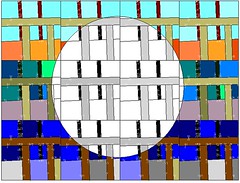
In my last TIF post I mentioned an unbidden image which came up for me when I read Sharon B's April TIF concept. I said I would incorporate that image into my April TIF challenge piece.The image was of myself as a baby in a crib. I've heard some stories over the years from various family members about those early days. Not all of them very happy ones. I have the sense that a lot of us may have been asked to spend quite a bit more time our cribs than was actually necessary. Just a guess. Probably for that reason, I'm not a big fan of cribs. Both my daughters slept with my husband and I for the first few months after which we moved them to a futon on the floor of their own bedroom. It was much easier to change the baby, put her down to sleep and easier to deal with her when she woke up crying in the night; we would just go in and lay down for a while on the bed. It worked for us. I thought about the crib image for a while, not sure how it might inspire a small quilt or piece of textile art. After awhile I came up with the idea of a repeat block based on the bars of a baby crib. Below left is an image cropped from a photograph of a crib. Below right is a quilt block based on the image.


Here is the block repeated four across, three down.


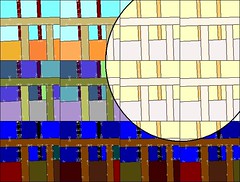
I added some colour, and an orb (below left),to suggest the sun rising, thereby representing the passage of time which I also said that I would incorporate into this piece. Then I shifted the orb to the right side of the piece (below right),


and simplified the whole thing somewhat by removing half of the blocks for a total of six blocks instead of twelve. I also flipped over some of the blocks to break up the patterning a bit. The sun then became a much bigger part of the overall composition.


I wasn't sure what kind of a time commitment this would turn out to be but the next step was to take it to fabric, which would represent the element of positive transformation that I also wanted to convey in the work. The idea of positive transformation is also addressed by taking a somewhat heavy memory and injecting it with colour and movement.

April TIF - Part III

Related posts: April TIF -Part I, April TIF - Part II

Here are the first six blocks pieced together. What I liked about making them was cutting the fabric free hand with the rotary cutter. The effect is that there's a bit of variety and movement added to the blocks.

6blocks

Looking at these six block I realized that I was moving away from my original colour scheme and that I was also spending more time on the project than I had originally intended or could afford. I had been wanting to make a quilted cover for our piano keyboard for quite some time. We have a small, apartment sized Yamaha with no keyboard cover built into it. Thus, the keys sometimes get quite dusty, (like when I haven't dusted for a while). When I laid the six blocks end to end, they fit the piano keyboard perfectly so I sewed them together end to end, like so.

4BlocksLong

Added batt and pin basted,

pinnedLong


quilted and bound, et voila, a happy piano and April's TIF challenge completed.

piano

Keyboard Cover
Commercial and hand
dyed cotton and silk
Machine pieced
Machine and hand quilted
8 x 52"
April 2008


detail_3

Detail

4.24.2008

Quilting as a metaphor

"[In] my 'Secret Garden' series [link]...I take as a starting point, old memories of gardens of my childhood with their combination of water paths and foliage. This also becomes a metaphor for deeply embedded old memories that rise unbidden in our consciousness; sometimes clear and structured, sometimes vague and formless. Quilt-making with its multiple layers seems an ideal medium for exploring these ideas." - Rosalie Dace
I have an opportunity to take a one week class with Rosalie Dace who is teaching at Quilting by the Lake this year. I have looked at her work on line [link][link] and read about her on a handful of websites and blogs. Her quilts are absolutely sumptuous and appeal to me directly. As well, she appears to be a process person; no patterns or kits provided. On her website she states that her interest is in helping students to bring out what is personal to them in their work, and to encourage them to stretch beyond what they think is possible for them. Great! I am hesitating to proceed though, because I attended a class at the same conference last year and had a very mixed experience, largely because the class I took was poorly organized and, I thought, did not deliver what had been advertised. I would hate to set aside this kind of time and financial resource again for a repeat experience. However, all things in life present certain risk, along with the concomitant possibility of benefit or great gain. So, I'll ponder on it for a few more days and think about the benefits that this experience has to offer. It has long been personal challenge for me to let go of preconceived expectations about how things should or shouldn't be, a challenge which requires a heightened trust in life and in people, and a willingness to allow things to unfold as they may.

4.02.2008

Quilt finished

I posted about this quilt early last year when I started putting it together. The design was inspired by a colour exercise in a book I was reading called The Interaction of Color by Joseph Albers. In the meantime, the finished quilt top has been hanging on my design wall where I have enjoyed looking at its brightly coloured squares while deciding what to do about the quilting. Last week I got to it.

First I machine quilted black
concentric circles offset from
the lower right-hand corner
and hand quilted quarter ovals
starting from the lower left-hand corner
which intersected the black circular
stitching,


then added a narrow black binding.


Colour study: The illusion of transparency
Hand dyed cottons, machine pieced,
machine and hand quilted
29 x 29"
March 2008


Detail

2.21.2008

TIF February 2008 - Part II

OK. This piece is finished. I don't have much to say about it. I added a couple of more details. As I'm not a big fan of appliqué I used acrylic paint for this. I got a bit hung up on it because of the fabric colours. Although I had not intended, the thing was already pretty dark, so placing a dark shadow on the front of it wasn't working for me. I wanted the 'shadow' of a child playing hopscotch to stand out on the front of the piece. I chose silver paint for that. Not sure I like it. I got the image that I wanted but it most definitely does not look like a shadow, hmmm. I also placed a fence across the front. I saw a space between two buildings there and I wanted to put a barrier across that space. One often finds fences near playgrounds.


finished_cropped

Hopscotch
Commercial and hand
dyed cotton, acrylic paint
Machine pieced and quilted
11 x 13"
February 2008


detail

Detail


Related post: TIF February 2008 - Part I

2.13.2008

February 2008 TIF - Part I

February's Take it Further challenge concept is this question:

What are old enough to remember?
Well, for starters,
  • Playing with tinker toys, pick-up sticks, hoola-hoops, jacks, metal slinkies, clamp-on roller-skates that tightened with a key, and playing hopscotch and double dutch
  • A $0.10 weekly allowance, going to Expo '67 in Montreal, cigarette ads on black & white TV, the Friendly Giant, Mr. Dressup, Ed Sullivan, Lawrence Welk, Laugh-In, Archie Bunker, Saturday Night Live and Monty Python's Flying Circus.
  • Rotary telephones, writing term papers on a typewriter, polaroid cameras, lava lamps (the first time around), 8-track tapes and the day my grandparent's bought their first colour television set
  • The assassination of Martin Luther King, the Black Panthers, the Weathermen, Patty Hurst, the Mai Lai Massacre, the end of the Vietnam war, the trial of the Gang of Four, the impeachment of Richard Nixon, the Quebec October Crisis, the defeat of Pierre Trudeau, the defeat of Joe Clark and diethylstilbestrol
  • Bell-bottom pants, platform shoes and hip-huggers
  • Mary Poppins, the Beatles and Jefferson Airplane
  • When a healthy diet meant regular servings of Campbell's soup, Wonder Bread, reconstituted powdered milk, hot dogs, bologna, jello and cheez-whiz (Ugh!)
  • Coke in a glass bottle, candy cigarettes, hard rock candy, 5 cent candy bars, jaw-breakers and Mary Janes
As I thought about how to condense these memories into a concept that I could work with, I read this post in which Linda at Tango Musings says this about February's challenge:
Yesterday I bought supplies for one idea, but still don't know if this is one I want to do, after all, those of us of a certain age all remember the first moon landing. It doesn't feel original enough to work on something that is so much a part of all of our psyche.
And it struck me that I'd much prefer to focus on one thing, something personal and compelling, rather than try to find a way to encompass a whole slew of things from the pile of memories. Looking over the list I had made, it was the games that we played when I was a kid that strike me as something which belong to bygone era. Low-tech and simple, usually involving a rope, or a ball, or a deck of cards, we played them for hours on end, got up the next day and did it all over again. Hopscotch was one of these, and I thought it would lend itself fairly well to patchwork. I would try to improvise a hopscotch game from patchwork and then superimpose the shadow of a child playing on it. I did a few flickr searches to find some visual inspiration and pulled out these shots. Thank you to the photographers for permission to post them*.

*Click on a photo above to visit the photographer's flickr account


Here's what's happened so far:


DSC04793

Two preliminary sketches
fabricPick
Fabric picks including colours
from February's palette
DSC04807
Starting the patchwork...
DSC04809


shadow
Making a girl's shadow...

DSC04796
...with the dark brown sheer. I was
hoping that the sheer fabric would
mimic a shadow by darkening the
underlying fabric while still showing
what was underneath.
DSC04832
'Hopscotch' - 11 x 13"
However, the sheer fabric doesn't work quite the way I want it to. Many of the fabrics underneath are too dark and the image of the girl playing does not come across clearly enough.

My next step will be to try to place something else across the front, such as a gate or fence. I like the way the border looks a bit like a doorway or the space between two buildings, and I think I'd like to see some kind of barrier across the open area between the right and left border blocking out some of the quilt - like a barrier between the past and the present.

We're halfway through the month and I think I have time to finish this. That's the goal anyway. Now I'm going to do something that I haven't had time to do yet this month, take a look at what other people have come up with for this month's challenge.